


The Hortillonnages of Amiens carry within them a founding tension: that of a nature that is eminently constructed, shaped by centuries of market gardening and hand-dug canals. Artifice and nature are not opposed here; they have merged into one another to the point of becoming inseparable. This dichotomy lies at the heart of the project : composing a space that is simultaneously garden, architecture and living territory. A space in which to become a bird, or to observe one.
The landscape project is organised in successive gradients, from the wild towards the built. The banks, left to the spontaneous dynamics of living things, form the first state. From them, several layers of garden unfold : tall wild grasses, flowering meadows, circulation lawn, through to the floor of the pavilion, the highest point of artifice. Each transition generates a biological richness that exceeds that of each of the environments it connects. Tall grasses and berry-bearing plants offer seeds and insects to birds, flowering meadows nourish pollinators, and the living things that feed, nest and move through this space meet the human beings who come to contemplate it.
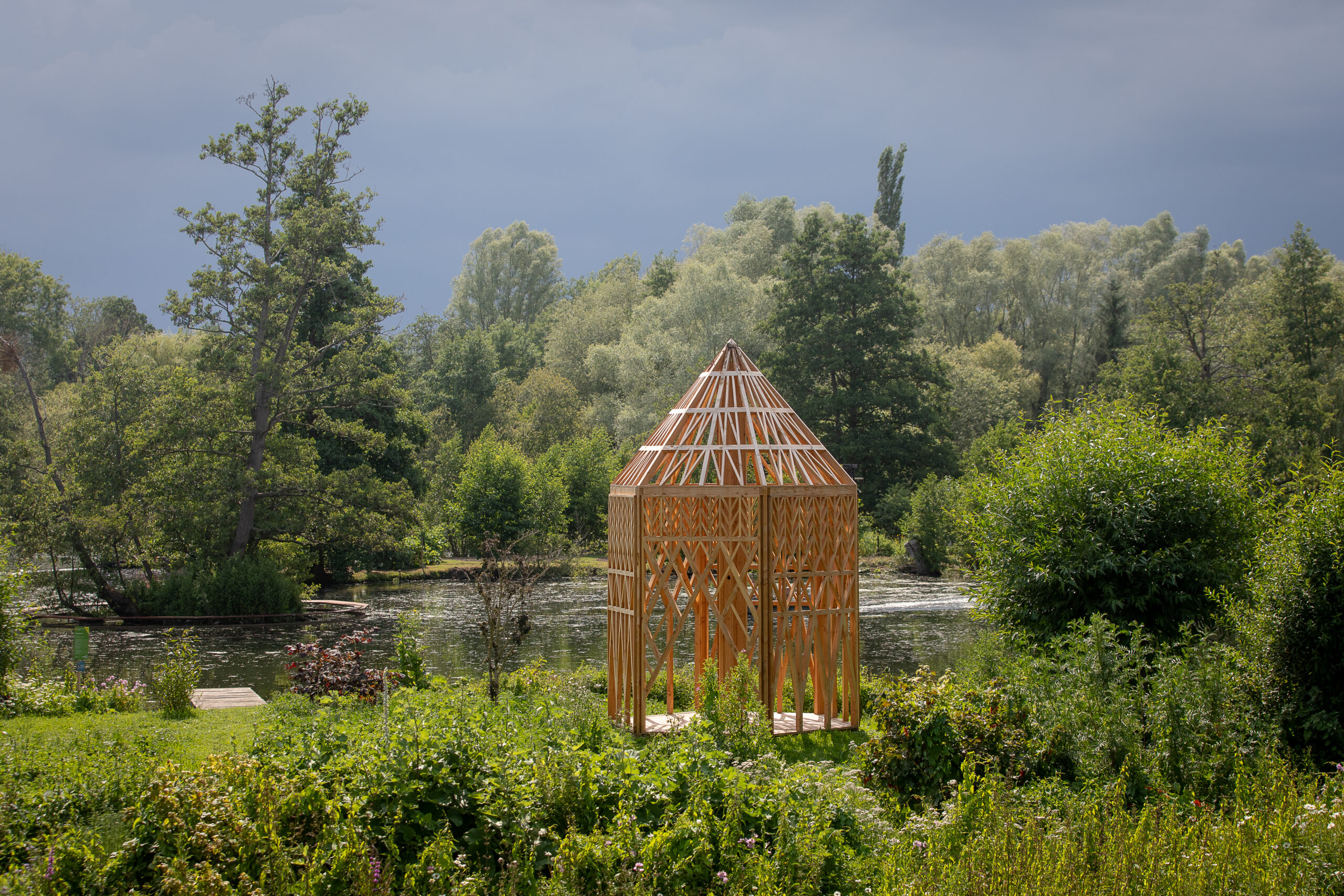
It is at the most constructed end of this gradient that the pavilion stands. To embody this vision of sharing, the project turns to a form deeply rooted in the territory: the dovecote. Both an agricultural and a noble structure, the pigeonnier was, until the French Revolution, a privilege reserved for the aristocracy. A nutritional reserve, a producer of fertiliser, a vector of communication, it concentrated within itself several forms of power. The project reverses its programme. The hexagonal form is retained, along with its central mast inherited from the échelles à picots, those uprights studded with pegs that once allowed access to the nesting boxes on the façade. But the timber framing, somewhere between structure and ornament, is no longer solid. Hollowed out, the panels become membranes, passages, temporary nesting spaces open to the interior as much as to the exterior. Their assemblies echo the traditional patterns of the half-timbered houses in the Saint-Leu quarter, which borders the Hortillonnages, rediscovering in certain interlocking forms the textures and rhythms of the surrounding natural landscape.
The six faces of the building are so many transitions, interstices of varying dimensions, passable by child and adult alike, by kingfisher and mallard. On entering, the visitor finds neither solid walls nor a closed ceiling : they are suspended between sky and water, within the porous intimacy of a collective nest. The open timber frames hold the landscape without enclosing it, allowing light, wind, gazes and, at times, the beat of wings to pass through. There is no longer an interior in the strict sense: inside and outside share the same condition, the same absence of hierarchy. No longer a place of possession, but a place of passage. No longer a symbol of domination, but a light armature that living things pass through, occupy and reinvent with each season. What was once the luxury of the few becomes common to all : a space of contemplation for human beings, a palace for birds.
Project realised with Artbois Construction (Timber Framing and Wood Construction, Amiens)